Conversion Therapies: Not Just Sticks and Stones
Words Can Do Harm Too

In a previous post I wrote about bans on gender affirming care that have been passed since 2021 in 27 Republican-dominated state legislatures. These bans are now being championed by the federal government.
In contrast, since 2012, 22 states with Democratic or bipartisan legislatures as well as Washington DC have enacted bans against conversion therapies for minors.
“Conversion therapies,” broadly speaking, are efforts to change an individual’s sexual orientation (that is the focus of their sexual attractions) or an individual’s gender identity (which refers to a person’s identification as either male, female or some other gender).
Like bans on gender affirming care, these laws have been challenged in state courts and to date, all of conversion therapy bans were upheld at the state level by their highest courts. When plaintiffs in those cases appealed to the US Supreme Court, in the not-too-distant past, SCOTUS refused to hear those cases.
However, on October 7 this year, SCOTUS agreed to hear the case of Chiles v Salazar, a challenge to Colorado’s ban on conversion therapy for minors. The challenge came from a religious therapist arguing that the ban violated her constitutional first amendment right to free speech. As it turns out, the current SCOTUS appears much more sympathetic to free speech arguments that would lead to overturning such bans.
This brought to mind an invited guest column I wrote for the New Jersey Star Ledger back in 2013 which, unfortunately, is no longer online. New Jersey was the second US state (after California) to pass a ban on conversion therapies. I have added [in parentheses] some updates to the original publication.
****
The Star-Ledger’s March 22 [2013] editorial, “Don’t Overreach on Gay Conversion Therapy” opposes the New Jersey Assembly passing a bill (A3371) banning “gay conversion therapy” for minors.
As a psychiatric expert critical of sexual conversion “therapies, I understand the editorial board’s concerns. I even shared similar views with a Star-Ledger reporter last fall after California passed its own ban. I was skeptical about legislation as the best way to deal with this issue since state laws would not affect the majority of conversion “therapy” practitioners who are mostly unlicensed.
Since that time, however, my thinking has evolved. Following a court challenge to California’s law, in February 2013 I submitted an amicus brief in its support. [After writing this column, I was also asked by the Attorney General of New Jersey to provide a declaration in support of the NJ ban]
What changed my mind? Initially I believed a law, by itself, is not the most efficient means of protecting the public from scientifically unproven “treatments.” Simply passing laws might create the erroneous impression that everything that needs to be done has been done and distract from needed efforts to educate oversight bodies. Licensing boards, regulatory agencies, and ethics committees of professional organizations are often woefully unfamiliar with the harm caused by conversion “therapies.” [For example, see this 2016 article on “The Growing Regulation of Conversion Therapy”]
I now believe legal bans can serve an additional purpose. They communicate to the general public the disdain in which a state holds these practices, whether performed by licensed or unlicensed individuals. They also strengthen the hand of plaintiffs in consumer fraud lawsuits against conversion “therapists,” such as the high profile case in New Jersey that names unlicensed individuals among the defendants. [In 2015, that case, Ferguson v JONAH, was decided in favor of plaintiffs who had been harmed by conversion therapy.]
Consequently, I no longer see legislation and education as an either/or proposition. A combination approach can best protect the public in general and minors in particular.
As for protecting minors, I disagree with the editorial’s assertion that parents have a right to “raise a child according to crackpot ideas.” If “crackpot ideas” harm children, states have seen fit to intervene. When parents, for religious reasons, try to withhold blood transfusions or needed medications from their children, the child’s best interests trump freedom of religion.
Finally, the editorial board opines that, “It’s strictly a form of talk therapy. And lawmakers have never outlawed any type of talk therapy. Do we really want them to decide what sort of speech should be allowed in your therapist’s office?”
While I share concerns about the slippery slope of what can and cannot be spoken in therapy, such restrictions already exist. Sexually propositioning a patient (even if the therapist and patient don’t have sex) may lead to loss of license in some states and ethical sanctions by most professional organizations.
While most people might not think talk is as obviously harmful as “medicine or electric shock,” in the clinical setting talk is not always benign and therapists can say things that hurt patients. Poorly managed talk therapy with depressed patients can sometimes precipitate suicide attempts. As an intern, I watched a psychiatric supervisor do a “stress interview” that made a patient so psychotic he had to be placed in a straightjacket. All they did was talk. Its not just sticks and stones that break people’s bones. Words can also harm.
Which is what often happens when conversion “therapists” tell people hurtful untruths such as, “You have a mental disorder, no matter what the American Psychiatric Association says.” Or “You are a homosexual because your parents didn’t raise you right.” Or “If you come out as gay you will probably die early and live an unhappy and unhealthy life.” Or “God will not love you if you are gay.”
When words like these are addressed to children by misguided authority figures delegated to do so by their parents, conversion “therapy” becomes more than just a crackpot idea meriting first amendment protection. And if this ban protects only one child, should that child not be protected from a barrage of harmful, hate speech?
I think so, which is why I urge the NJ Assembly to follow the lead of the NJ Senate and pass A3371 so that Governor Christie can sign the bill into law. [Which Republican Governor Christie did sign in August of 2013 and which Republican appointed Supreme Court justices now seem poised to overturn]
References
Drescher, J. (1998). I’m your handyman: A history of reparative therapies. J. Homosexuality, 36(1):19-42.
Drescher, J. (2015). Can sexual orientation be changed? J Gay & Lesbian Mental Health, 19(1):84-93.
Drescher, J., Schwartz, A., Casoy, F., McIntosh, C.A., Hurley, B., Ashley, K. et al. (2016). The Growing Regulation of Conversion Therapy. J Medical Regulation, 102(2):7-12.
Drescher, J. & Zucker, K.J., eds. (2006). Ex-Gay Research: Analyzing the Spitzer Study and Its Relation to Science, Religion, Politics, and Culture. New York: Routledge.
Drescher, J. (2023). Historical, Clinical and Ethical Perspectives: An update on I’m Your Handyman. In: Banning ‘Conversion Therapy,’ eds. I. Trispiotis & C. Purshouse. Oxford, Oxfordshire, UK: Hart Publishing, pp. 59-67.
Drescher, J. & Byne, W. (2024). Gay and lesbian identities, and homosexual behavior. In: Kaplan and Sadock’s Comprehensive Textbook of Psychiatry, 11th Edition, eds. R. Boland & M. Verduin. Philadelphia, PA: Wolters Kluwer, pp. 2057-2090.
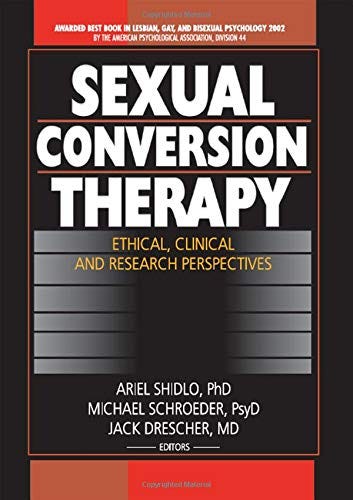
Shidlo, A., Schroeder, M. & Drescher, J., eds. (2001). Sexual Conversion Therapy: Ethical, Clinical and Research Perspectives. New York: CRC Press.